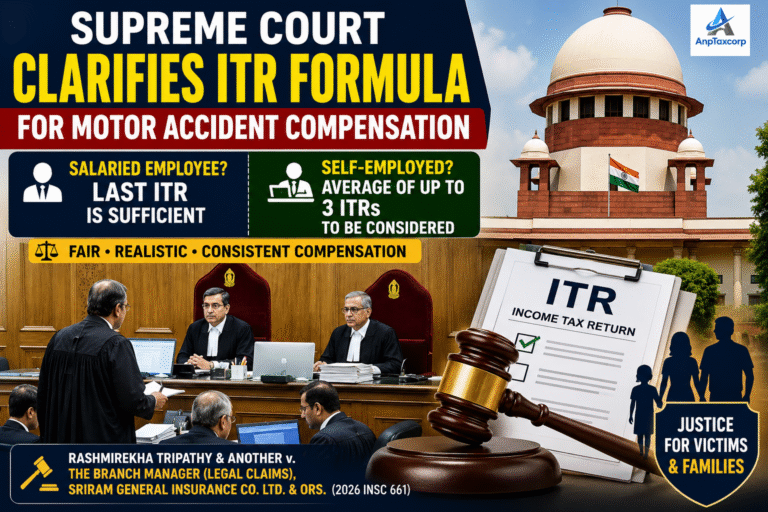
In a landmark judgment that brings much-needed clarity to the assessment of income in motor accident compensation claims, the Supreme Court of India has laid down a structured formula for determining the annual income of deceased victims under the Motor Vehicles Act, 1988.
The Court has ruled that for salaried individuals, the Income Tax Return (ITR) of the immediately preceding financial year is generally sufficient to determine annual income, whereas for self-employed individuals and business owners, the average income reflected in up to the previous three years’ ITRs should ordinarily be considered. The judgment is expected to bring greater consistency and fairness in calculating compensation payable to victims’ families.
Supreme Court Distinguishes Between Salaried and Self-Employed Individuals
The decision was delivered by a Bench comprising Justice Sanjay Karol and Justice Nongmeikapam Kotiswar Singh.
Recognizing that income patterns differ significantly between salaried employees and self-employed professionals, the Court observed that a uniform formula cannot be applied in every case.
For salaried employees, promotions, annual increments, and revised pay structures can substantially increase earnings within a short period. Consequently, the Court held that the ITR of the immediately preceding year ordinarily provides the most accurate picture of the deceased’s earning capacity.
The Bench further observed that there may be situations where an employee had recently received a promotion but had not yet completed a full financial year or filed an updated income tax return before the accident. In such circumstances, tribunals may rely upon supporting documents such as promotion letters, revised salary slips, employment records, and other financial evidence to determine actual income.
Average of Up to Three ITRs for Self-Employed Persons
The Court adopted a different approach for self-employed individuals, entrepreneurs, and business owners.
Unlike salaried employees, business income often fluctuates because of market conditions, investments, expansion plans, seasonal variations, or economic circumstances. Therefore, relying on only one year’s income may produce an inaccurate assessment.
Accordingly, the Supreme Court held that the average income reflected in up to the previous three Income Tax Returns should ordinarily serve as the benchmark while determining annual income for compensation purposes.
The Court also clarified that where only one or two ITRs are available, those returns may still be considered, along with surrounding facts and business circumstances.
Five Important Factors for Assessing Business Income
The judgment identifies several important considerations that Motor Accident Claims Tribunals should evaluate while assessing the income of self-employed persons.
These include:
- The nature and geographical location of the business.
- The growth trajectory of the business and the effect of the owner’s death on its operations.
- The future earning potential of the business, particularly where significant capital investment is expected to generate profits later.
- Initial years of business losses, which may not accurately reflect long-term earning capacity.
- Any other relevant commercial or financial circumstances affecting the business.
By emphasizing these factors, the Court acknowledged that business income cannot always be measured solely through numerical figures appearing in income tax returns.
Caution Against Relying on ITRs Filed After Death
The Supreme Court also addressed an issue frequently arising in compensation disputes—Income Tax Returns filed after the death of the claimant.
The Bench cautioned that such posthumous ITRs should be examined carefully, as there remains a possibility of income figures being artificially enhanced after the deceased’s death to claim higher compensation.
The Court held that post-death ITRs should ordinarily be accepted only when corroborated by supporting financial documents such as audited accounts, balance sheets, profit and loss statements, or other reliable business records.
This safeguard aims to preserve the integrity of compensation proceedings while ensuring that genuine claims are not unfairly rejected.
Odisha Construction Business Case
The leading appeal arose from a tragic road accident in Odisha in May 2018 involving a 39-year-old construction businessman.
The Motor Accident Claims Tribunal assessed his annual income at ₹15 lakh based on the immediately preceding Income Tax Return and awarded compensation of approximately ₹2.27 crore.
On appeal, the High Court averaged two ITRs showing annual incomes of ₹11.59 lakh and ₹15.06 lakh, reducing the compensation to ₹1.87 crore.
The Supreme Court found that the High Court had failed to adequately consider the characteristics and future potential of the deceased’s construction business. Taking these surrounding circumstances into account, the Court fixed the annual income at ₹14 lakh and enhanced the compensation to ₹1.97 crore.
Insurance Agent Case
In another connected appeal, the deceased was a 49-year-old insurance agent.
The High Court had calculated compensation by averaging income shown in four Income Tax Returns.
The Supreme Court disagreed, observing that performance-based professions often witness sharp variations in yearly earnings. Instead, the Court restricted the assessment to the average of the previous three years’ ITRs and determined the annual income at approximately ₹6.87 lakh, increasing the compensation payable to ₹87.09 lakh.
Wholesale Grocery Business Case
The third appeal involved a 28-year-old wholesale grocery store owner.
The dispute centered around two Income Tax Returns filed after the deceased’s death.
Since no supporting financial statements were produced to verify the accuracy of the declared income, the Supreme Court declined to rely entirely upon those returns. Instead, it assessed the annual income at ₹3.25 lakh and enhanced the compensation to ₹60.79 lakh.
No Universal Formula, Says Supreme Court
The Court clarified that there cannot be a rigid or mechanical formula for determining annual income in every motor accident compensation case.
While Income Tax Returns remain highly reliable statutory documents, tribunals must also evaluate the surrounding facts and evidence depending upon the occupation and nature of income of the deceased.
This balanced approach seeks to ensure that compensation awarded under the Motor Vehicles Act is both fair and realistic.
Conclusion
The judgment marks a significant development in motor accident compensation law. By drawing a clear distinction between salaried employees and self-employed individuals, the Supreme Court has introduced practical guidelines that are likely to reduce inconsistency in compensation awards across the country.
The ruling reinforces that the last Income Tax Return ordinarily determines the income of salaried employees, whereas the average of up to three previous ITRs, read along with surrounding business circumstances, should guide the assessment of self-employed individuals.
The decision in Rashmirekha Tripathy and Another v. The Branch Manager (Legal Claims), Sriram General Insurance Company Limited and Others is expected to serve as an important precedent for Motor Accident Claims Tribunals and appellate courts while determining just compensation under the Motor Vehicles Act.