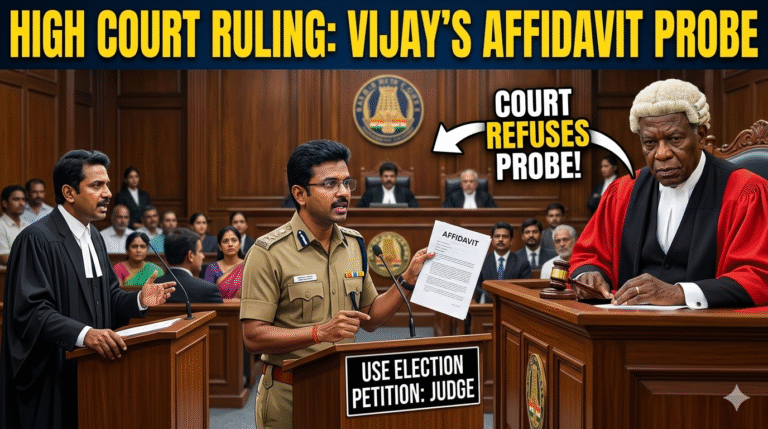
In a significant ruling reaffirming the constitutional limits on judicial intervention in election matters, the Madras High Court has refused to direct an investigation into the financial disclosures made by Tamil Nadu Chief Minister and Tamilaga Vettri Kazhagam (TVK) chief C. Joseph Vijay in his election affidavit.
The Court held that disputes relating to disclosures made in election affidavits cannot be examined through writ proceedings and must instead be challenged only through an election petition under the statutory election framework.
Background of the Case
The matter arose from a writ petition filed before the Madras High Court seeking directions to the Director General of Income Tax (Investigation) and the Election Commission of India to investigate the financial information disclosed by Vijay in Form 26 submitted along with his nomination papers for the Tamil Nadu Assembly elections.
The petitioner further requested that the findings of such an inquiry be made public before the conduct of elections.
However, the High Court declined to entertain the plea and dismissed the petition as not maintainable under constitutional and electoral law principles.
What the Court Held
The Division Bench comprising Chief Justice Sushrut Arvind Dharmadhikari and Justice G. Arul Murugan ruled that Article 329(b) of the Constitution creates a clear bar against judicial interference in election-related disputes except through an election petition.
The Court observed that once the electoral process is underway, challenges concerning nomination, affidavits, and related disputes are required to follow the mechanism specifically prescribed under election laws.
According to the Bench, the allegations raised regarding financial disclosures involved disputed questions of fact that require detailed examination and evidence gathering—an exercise unsuitable for writ jurisdiction.
The Court emphasised that such inquiries cannot ordinarily be undertaken either by the Returning Officer during scrutiny of nomination papers or by the High Court in proceedings under Article 226 of the Constitution.
Importance of Article 329(b) and Section 100 of the Representation of the People Act
The judgment relied heavily on Article 329(b) of the Constitution, which restricts courts from intervening in election matters except through election petitions.
The Bench also referred to Section 100 of the Representation of the People Act, 1951, which lays down specific grounds on which an election may be declared void.
The Court clarified that allegations of false declarations, suppression of material facts, or incomplete disclosures in election affidavits may become grounds for setting aside an election—but only after the election process and through proper statutory proceedings.
Reliance on Supreme Court Precedent
The Madras High Court placed reliance on the Supreme Court decision in Kisan Shankar Kathore v. Arun Dattatray Sawant.
Drawing from the Supreme Court’s reasoning, the Bench observed that while objections to an affidavit may be raised at the nomination scrutiny stage, the Returning Officer does not possess the authority to conduct a detailed factual investigation into disputed disclosures.
The Court noted that if, at a later stage, it is proved that a candidate knowingly submitted false information or concealed material facts in the affidavit, the election itself may be challenged on the ground that the nomination was improperly accepted.
Quoting the Supreme Court, the Bench reiterated:
“If it is ultimately proved that there was non-disclosure or suppression of material information, it may then be held that the nomination was improperly accepted.”
Why the Writ Petition Failed
The High Court concluded that the petitioner had chosen an incorrect legal remedy.
Since election laws provide a dedicated mechanism to challenge nomination-related irregularities, courts cannot bypass that framework through writ jurisdiction.
Accordingly, the writ petition was dismissed.
At the same time, the Court granted liberty to the petitioner to pursue remedies available under election law, including filing an election petition in accordance with statutory procedures.
Conclusion
The ruling reinforces a long-standing constitutional principle that election disputes must be resolved within the specialised legal framework created for electoral challenges.
The judgment serves as a reminder that allegations relating to election affidavits, including claims of false financial disclosures, cannot automatically trigger writ proceedings or investigative directions during the election process. Instead, such issues must be adjudicated through election petitions after following the process laid down under the Representation of the People Act.
Case Title: V. Vignesh v. Director General of Income Tax (Investigation) & Ors.
Case Number: W.P. No. 15673 of 2026